Physical Address
304 North Cardinal St.
Dorchester Center, MA 02124
Physical Address
304 North Cardinal St.
Dorchester Center, MA 02124

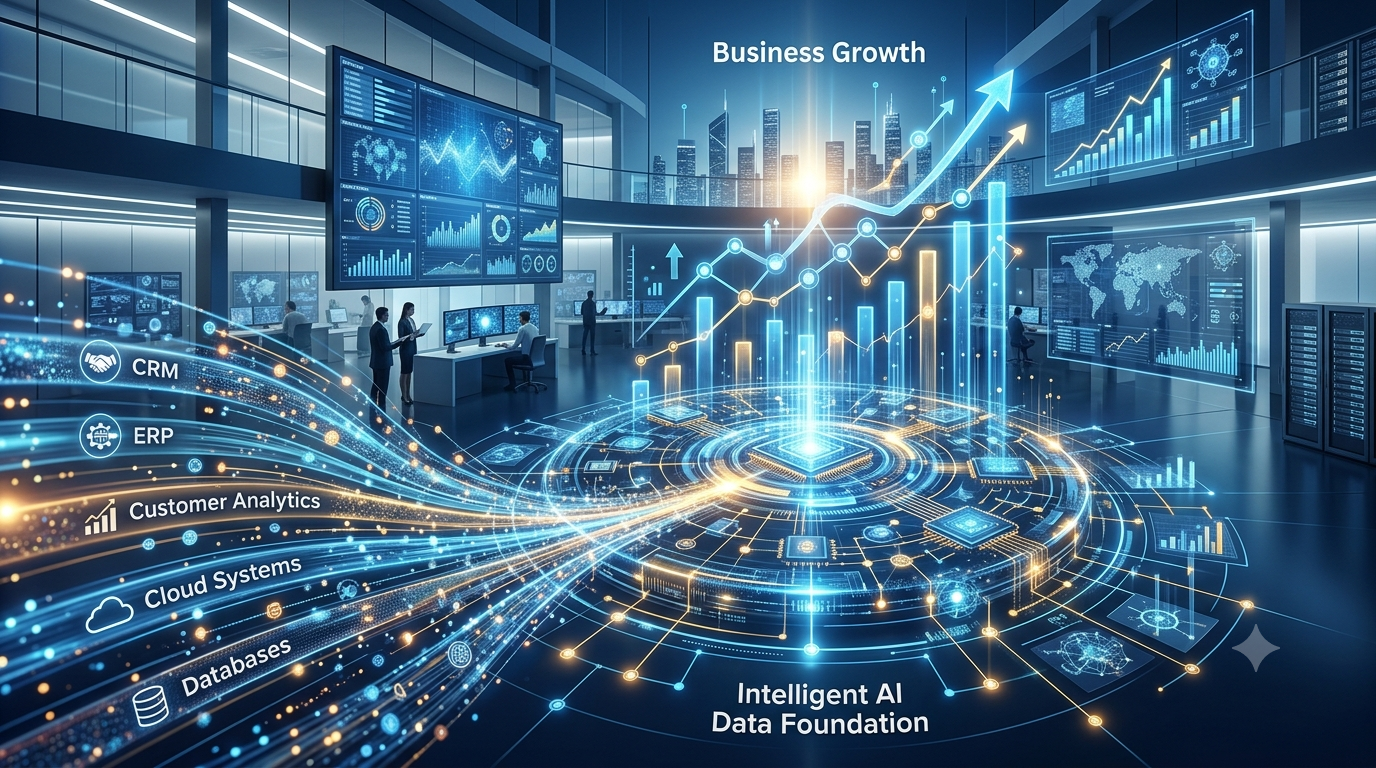
Artificial intelligence is moving from an experimental technology to an important business capability. Companies across industries are exploring AI for forecasting, customer service, marketing, operations, financial analysis, and productivity. Yet the organizations achieving the strongest results understand that AI success starts long before an AI model is introduced.
An AI-ready business needs a foundation that connects data, people, processes, and technology. When these elements work together, AI can become part of everyday business operations instead of remaining an isolated innovation project.
Every organization generates valuable information through customer interactions, transactions, websites, applications, employees, and operational systems. The challenge is turning this information into reliable intelligence.
Businesses should first identify their most valuable data sources and determine whether the information is complete, accurate, current, and accessible. Data quality problems can directly affect AI outcomes, making data preparation one of the most important stages of AI readiness.
Organizations should also reduce fragmentation. When customer, sales, finance, and operational information exists in disconnected systems, AI applications may lack the context needed to generate useful insights. Integrating important data sources creates a more comprehensive foundation for analytics and intelligent applications.
AI creates greater value when it is connected to measurable business problems. Instead of asking where AI can be used, leadership teams should identify areas where better prediction, automation, personalization, or decision support could create meaningful improvements.
For example, AI can help sales teams prioritize opportunities, customer-service teams handle common requests, and operations teams identify potential disruptions. The right use case depends on the organization’s goals, data availability, and operational maturity.
Businesses should begin with focused initiatives that can demonstrate measurable outcomes. Successful pilots can then become building blocks for broader AI adoption.
AI readiness is ultimately a business capability, not simply a technology upgrade. Companies that establish reliable data practices, connect technology with business processes, and prepare their workforce can create stronger conditions for AI-driven growth.
The businesses that benefit most from AI will not necessarily be those that adopt the largest number of tools. They will be the organizations that build the right foundation and use AI where it can produce clear, measurable business outcomes.